


Three Types of Account Bans on Facebook
Three Types of Facebook Account Bans in 2026: Solutions for Ad Accounts, Public Pages, and BMs
Published on 2026-04-12 17:49:03
In overseas advertising campaigns, Facebook remains one of the platforms with the strongest conversion capabilities, yet it also has some of the strictest risk-control measures. Many advertisers expanding internationally encounter similar issues:
Suddenly, their ad accounts get banned
Public pages face restrictions on ad delivery
The Business Manager (BM) is directly suspended, rendering all associated assets unusable
However, many people fail to realize that the reasons behind bans on ad accounts, public pages, and BMs are entirely different, as are the corresponding solutions. Using incorrect methods can even exacerbate risk controls. This article systematically breaks down the triggering factors, handling procedures, and long-term prevention strategies for these three common types of account suspensions.
I. How Can You Improve Your Facebook Account’s Longevity?
Before diving into specific analysis of each type of ban, it’s essential to clarify one fundamental premise:
Facebook’s risk control isn’t based on isolated decisions—it evaluates accounts, behaviors, and environments comprehensively.
Many cases where ads appear “compliant” yet still result in bans often stem not from the ad content itself, but rather from underlying account issues or improper usage practices.
Facebook Personal Accounts: The Foundation of Trust for All Advertising Assets
Within Facebook’s risk-control framework, ad accounts, public pages, and Business Managers don’t operate independently. Whether creating an ad account, linking a page, or managing a Business Manager, the system ultimately traces back to the personal account (profile).
In other words, the credibility of a personal account sets the baseline for all subsequent advertising assets.
If a personal account exhibits any of the following characteristics:
(1) A short registration period coupled with frequent participation in ad-related activities within a brief timeframe
(2) Minimal genuine social interactions, used solely for asset management
(3) A persistent mismatch between login location and registered address, or frequent changes in network environment
Even if the ad content itself doesn’t clearly violate policies, such accounts may be flagged as “low-trust” during system evaluation, triggering restrictions at the ad account or Business Manager level.
Before explaining the various types of Facebook account bans, it’s important to note that the following key considerations regarding overseas business account usage apply universally to all Facebook accounts.
1. Choose a Durable Account
Avoid using newly registered accounts or those of unclear origin. In contrast, accounts with longer registration histories, rich activity records, and established friend networks typically enjoy higher baseline trust scores within Facebook’s system.
(1) A Facebook personal account more likely to endure over time usually shares the following traits:
(2) A relatively long registration period without prolonged periods of inactivity
(3) Natural friendships, active interactions, and visible content consumption patterns
(4) Normal day-to-day functionality, rather than being confined exclusively to administrative roles
(5) A stable login environment, free from frequent unexpected redirections
Although Facebook does not publicly disclose its exact criteria, extensive observations of account suspension cases reveal that the system tends to favor accounts with consistent behavioral patterns and logical usage habits.
For this reason, many advertisers opt early in their operations to leverage existing accounts with complete historical activity rather than starting from scratch, thus avoiding the high initial uncertainty associated with new registrations.
2. Select High-Quality Static Residential IPs
Facebook’s risk control doesn’t focus solely on ad content—it assesses IP type (residential vs. data center), whether IPs are shared among multiple users, and whether login locations change frequently.
This explains why more and more advertisers are turning to high-quality static residential IPs to ensure exclusive access for their accounts. Especially when managing multiple accounts, avoid logging into several accounts using the same IP address, as this could lead to account suspension.
A more prudent approach is:
One account per fingerprinted environment + one dedicated static residential IP (such as IPFoxy)
(1) IPFoxy’s residential proxy IPs originate from real ISPs, offering global coverage and allowing configuration aligned with the account’s registered address.
(2) Stable configurations minimize the risk of unexpected logins by reducing frequent changes.
(3) One account, one environment, one IP—ideal for long-term operation of ad accounts, Business Managers, and pages.
For advertisers managing multiple accounts, Business Managers, or collaborating teams, a stable, controllable IP environment essentially serves as the foundational infrastructure for effective risk management.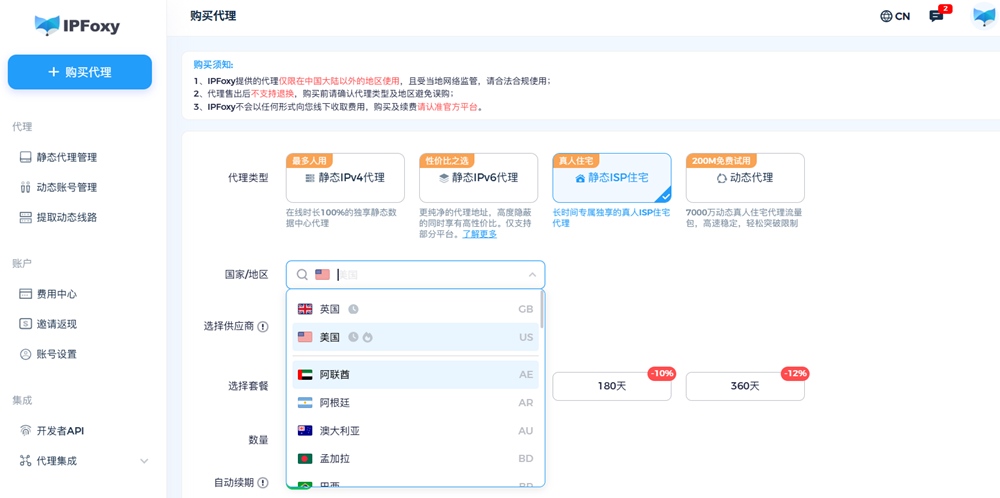
II. Three Types of Facebook Account Bans and How to Resolve Them?
Once you’ve understood the foundational aspects of your account and environmental factors, examining the three most common types of account bans becomes much clearer.
(I) Facebook Ad Account Ban
1. Common Signs of a Banned Account
(1) The ad account status displays “Disabled”
(2) Unable to create or run new ads
(3) Alerts indicating violations of Advertising Policies
A banned ad account doesn’t necessarily mean the ad content itself violates policies; many cases are linked to account behavior and environmental factors.
2. Core Reasons Behind Ad Account Bans
(1) Overly Aggressive New Account Operations
- Launching ads immediately after creation
- Setting excessively high initial budgets
- Frequent, rapid changes to creative assets, copywriting, and links within a short timeframe
Facebook classifies these actions as “unnatural advertising behavior.”
(2) Risk Signals in Ad Creatives or Landing Pages
- Promising exaggerated results, especially in finance or health sectors
- Landing pages with slow loading times, abnormal redirects, or significant mismatches between ad descriptions and actual content
- Domain history showing questionable origins
(3) Abnormal IPs and Login Environments
- Sharing the same IP across multiple ad accounts
- Frequent changes in country or region
- Using data center IPs or public proxies
Many advertisers assume that “as long as the content is fine, everything will be safe,” but IP addresses represent a critical dimension in Facebook’s risk-control process.
(4) Account Operation Issues
False account information, registering under fake names or identities, or long-term logins from IPs located far away from the registered address.
Invalid credit cards, repeated payment rejections, inaccurate billing addresses, or the use of suspicious prepaid cards.
3. How to Resolve an Ad Account Ban?
- Identify the specific violation type (and determine if an appeal is possible)
- If the ban was accidental, submit an appeal through Business Support
- For systematic risk-control bans, forced appeals have low success rates
- Refrain from repeatedly appealing the same account, as this may amplify risk labels

(II) Facebook Public Page Ban
1. Common Symptoms of a Banned Public Page
- Unable to run ads on the page
- Restricted ability to post content
- Direct removal of the page
Even if the ad account remains operational, any issues with the page prevent ad delivery.
2. Typical Causes of Public Page Bans
(1) Content Violations or Mass Reports
- Engaging with sensitive topics
- Manipulating user behavior (misleading clicks, panic marketing)
- Malicious reports from competitors, along with numerous user complaints alleging spam or fraudulent activity on the page
(2) Too Short a History Combined with Direct Commercialization
- Newly created pages
- Almost no regular content
- Immediately used for ad placement
- Facebook places greater trust in pages that resemble established brands
(3) Administrator Irregularities
- Multiple pages managed by the same IP
- Administrators frequently switching regions for login
- Using unstable network environments
When an administrator’s personal account gets banned due to violations, all pages they manage may also be affected.
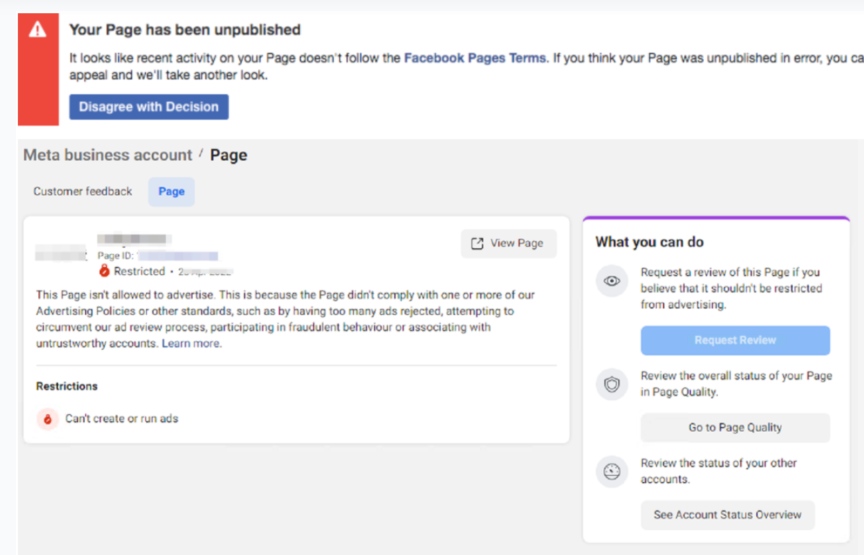
3. Approaches to Handling Public Page Bans
(1) Verify whether the page supports appeals—whether the restriction is temporary or permanent
(2) Optimize the page’s content structure (reduce non-advertising content), establish clear posting guidelines, and ensure all content—including UGC interactions—meets community standards
(3) If the page faces permanent restrictions, consider discontinuing binding to core ad accounts
(4) Strengthen administrator oversight by adding only trusted administrators and ensuring their personal accounts remain healthy and accurately documented. Regularly review the administrator roster.
(III) Business Manager (BM) Ban
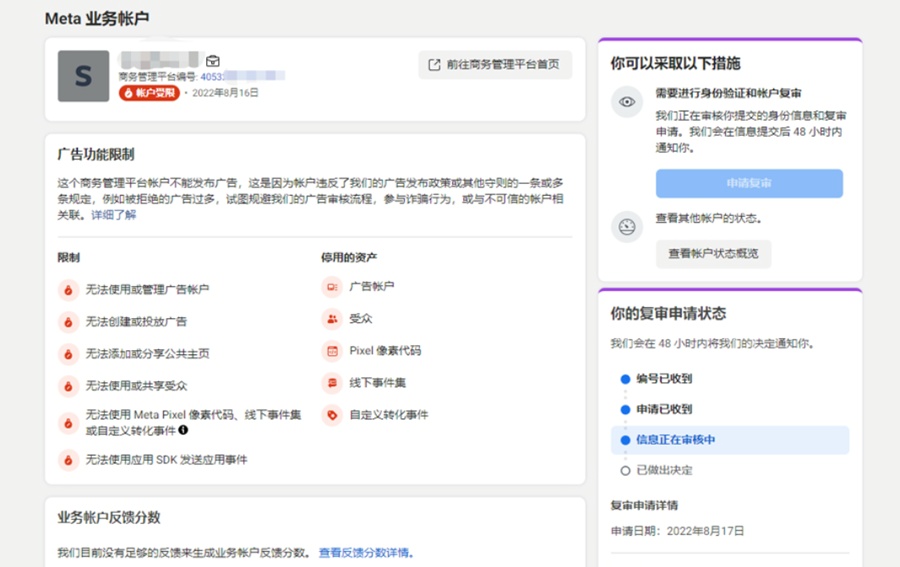
1. What Does a BM Ban Mean?
- All ad accounts become inaccessible
- All pages, pixels, and domains are impacted
- New ad asset creation is restricted
A BM ban typically doesn’t stem from a single issue but rather from a comprehensive risk assessment, potentially affecting all subordinate assets—ad accounts, pages, Pixels, and more.
2. High-Risk Factors Leading to BM Bans
(1) Excessively High Rates of Asset Violations Under the BM
- Multiple ad accounts already banned
- Several pages restricted
- Highly similar ad content
- Adding assets unrelated to the company (such as additional pages) or competing with another BM for the same resources
(2) Associated Risk of Violations
- One individual managing multiple high-risk BMs
- Administrators with prior violation histories
- Multiple BMs sharing the same network environment
- Any severe violation involving an ad account or page within the BM could trigger a blanket ban on the entire BM, labeling it as “high-risk”
(3) Long-Term Use of Low-Quality IPs
- Data center IPs
- Abused proxy IPs
- Severe mismatches between country and business operations
At the BM level, IP and account associations carry significant weight.
3. Can a Banned BM Be Recovered?
(1) Attempts at appeal may yield limited success; if deemed a systemic violation, recovery is often difficult
(2) Avoid creating new BMs under the same conditions
(3) Implement strict asset admission protocols, admitting only fully compliant, healthy accounts and pages into the BM, while conducting monthly checks on asset statuses, administrator rosters, and permission settings
(4) Complete enterprise verification: Early completion of enterprise verification for the BM significantly boosts credibility and appeal success rates.
III. Three Core Elements for Long-Term Facebook Account Survival
From a long-term operational perspective, Facebook account bans rarely result from a single mistake—they’re often the cumulative effect of multiple overlapping risk signals.
Stable operations generally hinge on three simultaneous conditions:
(1) A healthy account foundation (personal account history and behavioral profile)
(2) A consistently stable network environment (exclusive IPs and uniformity)
(3) An operational rhythm aligned with the account’s stage (gradual scaling rather than aggressive expansion)
Within this framework, Account Planet primarily addresses foundational account issues, IPFoxy tackles network environment concerns, while the pace of operations depends entirely on the advertiser’s own strategy and execution.
IV. Final Thoughts
Many Facebook account bans aren’t caused by isolated errors, but rather by the combined impact of content, behavior, and environmental risk signals.
If you aim to:
Run Facebook ads stably over the long term
Manage multiple ad accounts/Business Managers
Reduce the likelihood of unannounced account bans
Then, beyond ad creatives and campaign strategies, maintaining a solid account foundation and a stable network environment are equally critical factors that cannot be overlooked.